
Capturing Intent Flow: A Graceful Degradation Model for Multi-Agent AI
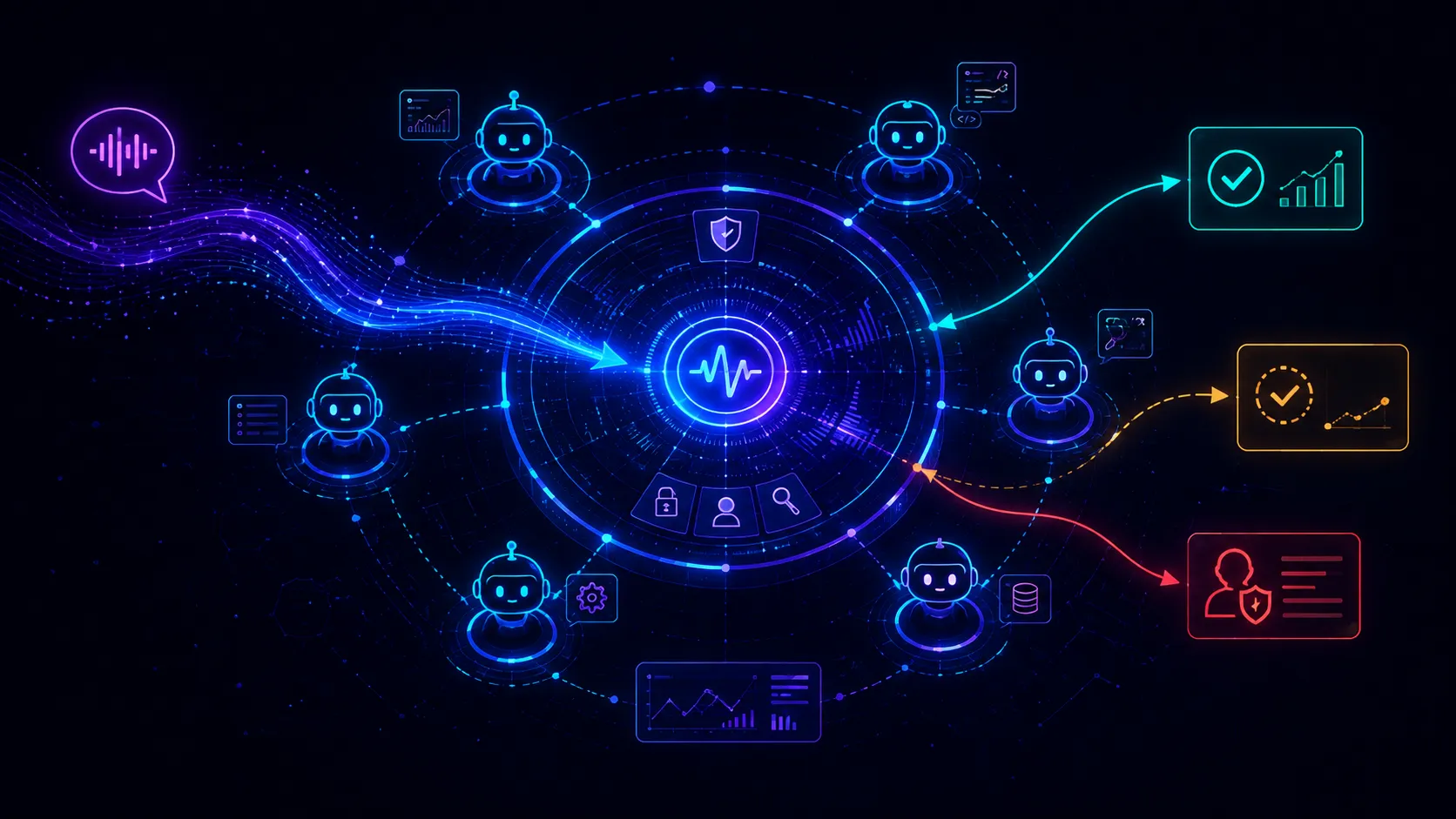
Building an intent classifier for LangChain-based multi-agent systems.
The gap between a proof-of-concept AI agent and a production-grade system often comes down to architecture. Recent reports detailing why enterprise AI projects fail highlight a consistent theme: a lack of visibility, governance, and architectural rigor.
To build reliable multi-agent systems, we must focus on a fundamental building block: intent capture.
The Central Role of Intent
Modern agent systems rarely pass a single prompt through a single model. Instead, incoming requests are evaluated, classified, and routed to specialized agents or tools.
That initial classification step—determining intent—is the most information-dense event in the entire system lifecycle. Intent serves two critical functions:
- Routing Accuracy: Expecting a single LLM to reliably select from hundreds of tools causes accuracy to degrade sharply as the catalog scales. By placing an intent classification step upfront, you narrow the tool namespace, keeping both routing accuracy high and inference costs low.
- Observability and Governance: If you can extract and track the classified intent, you can measure routing quality, detect model drift, debug misroutes, and enforce authorization policies. Without intent visibility, the system remains a black box that fails unpredictably.
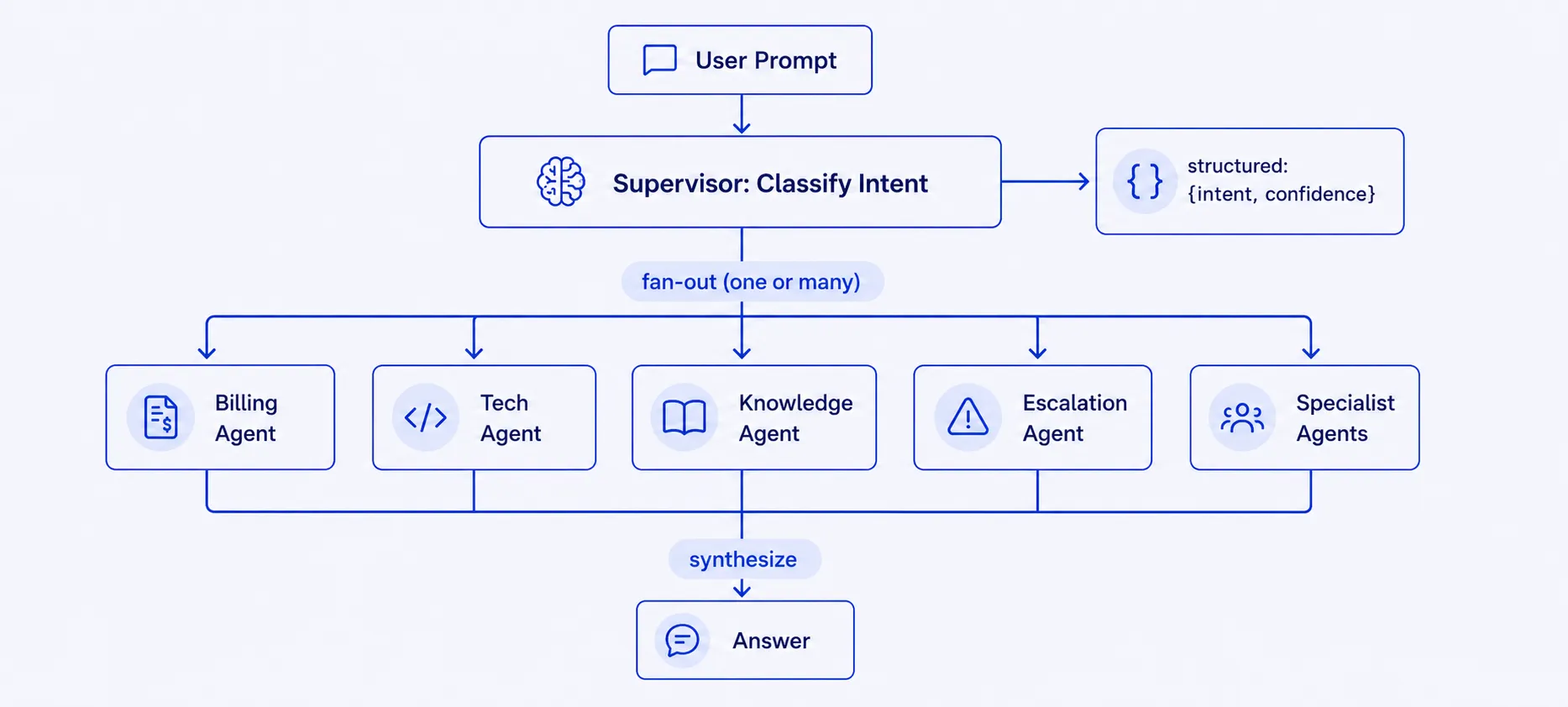
To illustrate this, consider a customer support assistant built using LangGraph. The system uses a supervisor pattern to route incoming requests to specialized agents.
How the Workflow Operates
- Intent Classification: The supervisor node reads the user prompt and outputs a structured schema containing the intent label, a confidence score, and a justification.
- Specialist Dispatch: The supervisor fans out the request to one or more specialized, tool-using agents (e.g., billing, technical support, product knowledge, or escalation).
- Synthesis: For cross-domain queries (e.g., "I was charged for a feature that is broken, I want a refund and a fix"), the supervisor dispatches to both billing and technical support, merging their outputs into a single, cohesive response.
While this routing pattern solves the orchestration challenge, it introduces a critical security nuance: a self-declared intent is not an absolute security boundary. An agent subjected to an indirect prompt injection attack may claim a benign intent while attempting a malicious action. To build a secure system, intent must be captured, verified, and enforced at the control plane.
The Intent Capture Hierarchy: A Graceful Degradation Model
Capturing a user prompt is simple; capturing an agent’s internal intent is not. How you extract intent depends entirely on how much of the execution environment you control.
We can categorize intent capture across three distinct rungs, starting from the most deeply coupled to the most universal. A well-designed architecture uses the highest available rung and gracefully degrades to lower rungs when necessary.
Rung 1: In-Framework Callbacks
When you own the application code, framework-native callbacks (such as LangGraph hooks) provide the highest fidelity. A single registered handler observes the prompt at entry, extracts the classified intent and confidence score directly from the routing node, and captures the final output. This offers deep internal visibility at the cost of framework lock-in.
Rung 2: OpenTelemetry Standards
When working across diverse frameworks or languages, OpenTelemetry provides a vendor-neutral middle ground. Using OpenTelemetry GenAI semantic conventions, you can export prompts, tool selections, token usage, and custom attributes as standard spans via OTLP to observability backends like Datadog. While this standardizes data capture across your stack, it relies on what the underlying SDK actively exposes rather than reaching into deep framework internals.
Rung 3: Boundary Derivation for Managed Agents
When integrating third-party or fully managed platforms (such as Microsoft Copilot Studio), you cannot inject callbacks or telemetry agents. The system must capture data at the network or MCP gateway level. Because managed platforms do not expose their internal reasoning steps, the payload crossing the boundary contains the raw prompt but lacks the internal intent. At this rung, the control plane must derive the intent independently by evaluating the incoming prompt before passing it downstream.
Control-Plane Intent and Runtime Authorization
Capturing intent across these three rungs transitions intent from a passive observability metric into an active security primitive. Standard IAM and EDR solutions rely on static roles and permissions, making them highly ineffective at evaluating high-velocity, non-linear agent behaviors.
By unifying intent capture into a control plane, you can implement true runtime authorization:
Key Security Components
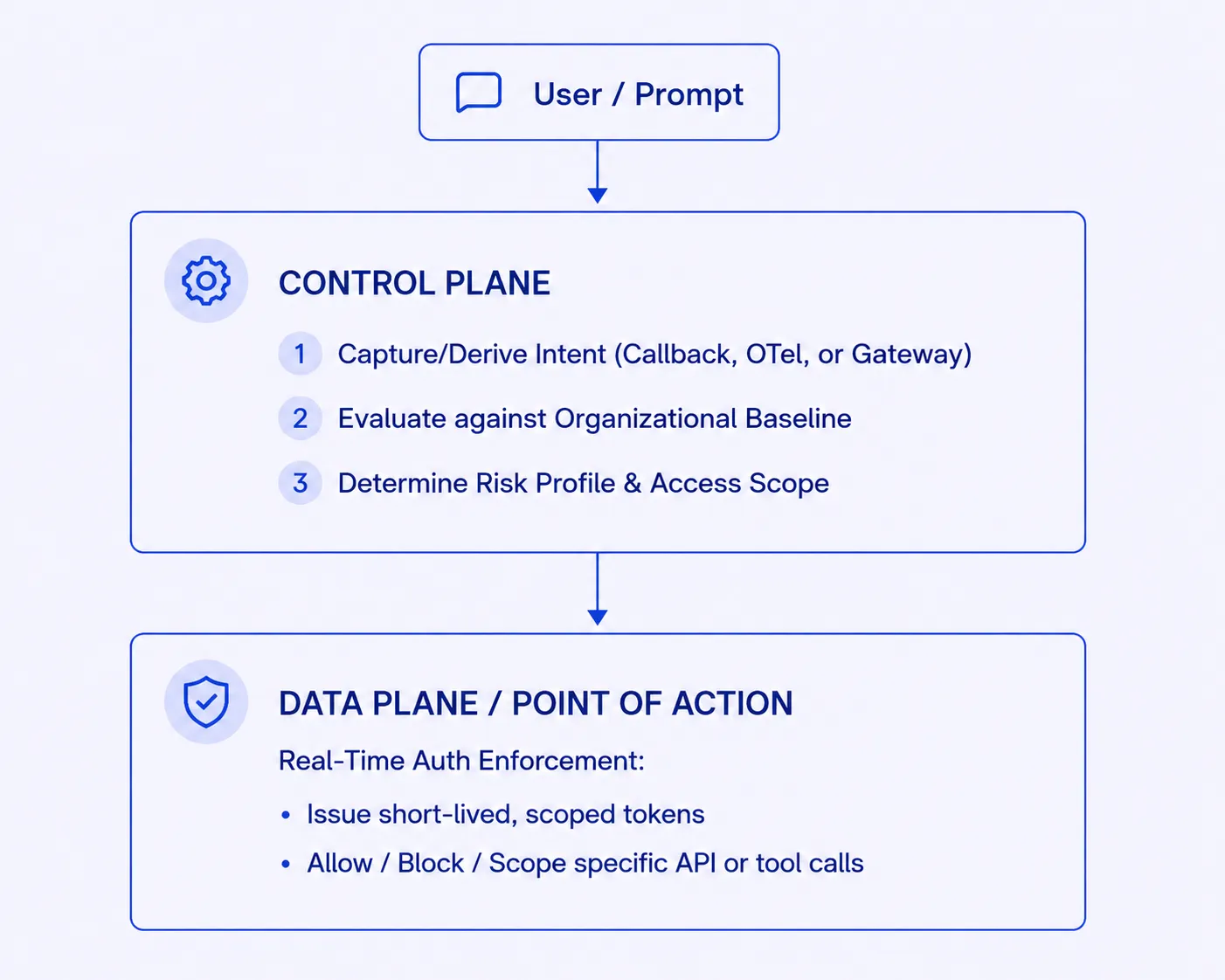
- Decoupling Evaluation from Execution: Traditional identity systems confirm who an agent is, but fail to evaluate what it is attempting to do. Decoupling the control plane (which classifies and verifies intent) from the data plane (which enforces authorization) allows security policies to evaluate context, target resources, and execution paths in real time.
- Intent-Aware Governance vs. Static Policies: Pre-defined RBAC rules crumble when an LLM selects a novel sequence of tool calls. By comparing classified intent against an organizational baseline, the control plane determines whether an unexpected execution path is valid problem-solving or an anomaly—such as privilege escalation or indirect prompt injection.
- Just-in-Time, Scoped Authorization: Rather than provisioning agents with long-lived, high-privilege credentials, authorization is granted per action. The control plane translates verified intent into short-lived, tightly scoped execution tokens, ensuring that tool calls and data access streams are restricted strictly to what the immediate task requires.
Conclusion
Building resilient, secure multi-agent systems requires viewing intent as a core architectural asset rather than an afterthought.
By structuring intent capture as a graceful degradation model—moving from native framework callbacks, to OpenTelemetry, down to gateway-level derivation—you can create a unified control plane. This control plane not only stabilizes agent routing and observability, but serves as the necessary foundation for real-time, intent-aware authorization across both custom and managed enterprise AI agents.
References
- Intent classification in agent routers: The tool-count accuracy curve
- OpenTelemetry: AI agent observability and the GenAI semantic conventions
- Datadog: Native support for the GenAI conventions in observability backends
- Fiddler: OpenTelemetry standardizes capture, not evaluation
- Microsoft Learn: Capturing Copilot Studio telemetry with Application Insights
Building an intent classifier for LangChain-based multi-agent systems.
The gap between a proof-of-concept AI agent and a production-grade system often comes down to architecture. Recent reports detailing why enterprise AI projects fail highlight a consistent theme: a lack of visibility, governance, and architectural rigor.
To build reliable multi-agent systems, we must focus on a fundamental building block: intent capture.
The Central Role of Intent
Modern agent systems rarely pass a single prompt through a single model. Instead, incoming requests are evaluated, classified, and routed to specialized agents or tools.
That initial classification step—determining intent—is the most information-dense event in the entire system lifecycle. Intent serves two critical functions:
- Routing Accuracy: Expecting a single LLM to reliably select from hundreds of tools causes accuracy to degrade sharply as the catalog scales. By placing an intent classification step upfront, you narrow the tool namespace, keeping both routing accuracy high and inference costs low.
- Observability and Governance: If you can extract and track the classified intent, you can measure routing quality, detect model drift, debug misroutes, and enforce authorization policies. Without intent visibility, the system remains a black box that fails unpredictably.
To illustrate this, consider a customer support assistant built using LangGraph. The system uses a supervisor pattern to route incoming requests to specialized agents.
How the Workflow Operates
- Intent Classification: The supervisor node reads the user prompt and outputs a structured schema containing the intent label, a confidence score, and a justification.
- Specialist Dispatch: The supervisor fans out the request to one or more specialized, tool-using agents (e.g., billing, technical support, product knowledge, or escalation).
- Synthesis: For cross-domain queries (e.g., "I was charged for a feature that is broken, I want a refund and a fix"), the supervisor dispatches to both billing and technical support, merging their outputs into a single, cohesive response.
While this routing pattern solves the orchestration challenge, it introduces a critical security nuance: a self-declared intent is not an absolute security boundary. An agent subjected to an indirect prompt injection attack may claim a benign intent while attempting a malicious action. To build a secure system, intent must be captured, verified, and enforced at the control plane.
The Intent Capture Hierarchy: A Graceful Degradation Model
Capturing a user prompt is simple; capturing an agent’s internal intent is not. How you extract intent depends entirely on how much of the execution environment you control.
We can categorize intent capture across three distinct rungs, starting from the most deeply coupled to the most universal. A well-designed architecture uses the highest available rung and gracefully degrades to lower rungs when necessary.
Rung 1: In-Framework Callbacks
When you own the application code, framework-native callbacks (such as LangGraph hooks) provide the highest fidelity. A single registered handler observes the prompt at entry, extracts the classified intent and confidence score directly from the routing node, and captures the final output. This offers deep internal visibility at the cost of framework lock-in.
Rung 2: OpenTelemetry Standards
When working across diverse frameworks or languages, OpenTelemetry provides a vendor-neutral middle ground. Using OpenTelemetry GenAI semantic conventions, you can export prompts, tool selections, token usage, and custom attributes as standard spans via OTLP to observability backends like Datadog. While this standardizes data capture across your stack, it relies on what the underlying SDK actively exposes rather than reaching into deep framework internals.
Rung 3: Boundary Derivation for Managed Agents
When integrating third-party or fully managed platforms (such as Microsoft Copilot Studio), you cannot inject callbacks or telemetry agents. The system must capture data at the network or MCP gateway level. Because managed platforms do not expose their internal reasoning steps, the payload crossing the boundary contains the raw prompt but lacks the internal intent. At this rung, the control plane must derive the intent independently by evaluating the incoming prompt before passing it downstream.
Control-Plane Intent and Runtime Authorization
Capturing intent across these three rungs transitions intent from a passive observability metric into an active security primitive. Standard IAM and EDR solutions rely on static roles and permissions, making them highly ineffective at evaluating high-velocity, non-linear agent behaviors.
By unifying intent capture into a control plane, you can implement true runtime authorization:
Key Security Components
- Decoupling Evaluation from Execution: Traditional identity systems confirm who an agent is, but fail to evaluate what it is attempting to do. Decoupling the control plane (which classifies and verifies intent) from the data plane (which enforces authorization) allows security policies to evaluate context, target resources, and execution paths in real time.
- Intent-Aware Governance vs. Static Policies: Pre-defined RBAC rules crumble when an LLM selects a novel sequence of tool calls. By comparing classified intent against an organizational baseline, the control plane determines whether an unexpected execution path is valid problem-solving or an anomaly—such as privilege escalation or indirect prompt injection.
- Just-in-Time, Scoped Authorization: Rather than provisioning agents with long-lived, high-privilege credentials, authorization is granted per action. The control plane translates verified intent into short-lived, tightly scoped execution tokens, ensuring that tool calls and data access streams are restricted strictly to what the immediate task requires.
Conclusion
Building resilient, secure multi-agent systems requires viewing intent as a core architectural asset rather than an afterthought.
By structuring intent capture as a graceful degradation model—moving from native framework callbacks, to OpenTelemetry, down to gateway-level derivation—you can create a unified control plane. This control plane not only stabilizes agent routing and observability, but serves as the necessary foundation for real-time, intent-aware authorization across both custom and managed enterprise AI agents.
References
- Intent classification in agent routers: The tool-count accuracy curve
- OpenTelemetry: AI agent observability and the GenAI semantic conventions
- Datadog: Native support for the GenAI conventions in observability backends
- Fiddler: OpenTelemetry standardizes capture, not evaluation
- Microsoft Learn: Capturing Copilot Studio telemetry with Application Insights